The Prankster Director's Blog: Tony Vidal

Site search

September 2010
M T W T F S S
« Aug    
 12345
6789101112
13141516171819
20212223242526
27282930  

Categories

Tags

Official Sites

Bookmark and Share

Making Movies: Raw, Half-Baked and Fully Baked Reflections on the Filmmaker’s Journey – VI

WORK THE SCRIPT.  The most fundamental aspect of film storytelling is the script.  Without a good script you simply cannot make a good movie.  So why is it that the vast majority of films, including huge Hollywood productions, fail on the level of script?  There are two issues involved.

First, many filmmakers do not honor the importance of script.  They are in a rush to get into production and figure they’ll correct story problems as they go along.  We’ll fix it in production, or better yet, we’ll fix it in post!  Yeah, right.  Almost inevitably, such an approach leads to confusion on the set, and despair in post.  It is inconceivably appalling that new pages are being written the night before, or the actual day a scene is shot.  I’m all for adjustments and some level of improv, but all too often this last minute scripting is an ill-fated attempt to address story problems that should have been faced months earlier.

If you are in a hurry to get into production, ask yourself why?  What is your motivation?  Usually, filmmakers are impatient and overanxious to get to the set, to start filming, to move closer to the realization fo their “dream.”  I can’t really blame them – I’ve been there.  But one thing I learned is that you can’t fix a script on the set or in post.  You need to work the script to your complete satisfaction before a camera ever rolls.  That way, you have a solid baseline for a successful production.  A good script, only competently executed on film, will succeed with its audience.  A flawed script, given the best execution money can buy, will usually fail.  Yes, there have been bad or only average scripts that have been turned into financially successful movies.  These movies usually rely on gimmicks and/or cast to win an audience.  But such cases are rare.  In any case, it’s an uphill, almost hopeless battle without a good script.

The second issue, after acknowledging that having a good script is important, is discerning what is a good script?  Many people pay lip service to the notion that having a good script is essential, but this doesn’t mean anything unless they have the discernment, or process,  for recognizing a good script. 

This is a serious problem.  Many people mistake their opinion as evidence of a script’s quality.  People with absolutely no literary or film background (some of them heads of studios) take their opinion as a crucial if not final barometer of a script’s value.  Professional screenwriters working on a project are befuddled by script notes from anybody and everybody.  The bottom line is that fundamental principles and qualified authority are not acknowledged in the film business.  Just because someone can read or write, they think they can judge – or worse yet, create – a viable screenplay.

Think about this for a moment – if you wanted to become an ace trial lawyer, or a respected brain surgeon, you automatically know you would have to go to college, law or medical school, then an internship, then gain several years of experience.  In short, you are looking at an eight to twelve year process, minimum.  Why should it take less time for someone to learn to be a great screenwriter?  There are far fewer great screenwriters than there are ace lawyers or crack surgeons.  But people with no training or experience, who go out and buy Final Draft, figure they are ready to turn out a great screenplay.

Picture this.  A brain surgeon in the middle of an operation is stopped and given notes – by everyone in the operating theater, even by the custodian in the hall.  Funny stuff, huh?  But that’s what’s done to writers.  Their craft is not respected.  Since this disrespect is the status quo, the way things have always been done, no one questions its absurdity.

Be that as it may, your job as a filmmaker is to be able to recognize or develop a good script.  So how is that done, you ask?  First, don’t just rely on your own opinion, especially if it is an opinion that is not informed by years of training or a track record.  You need to seek out writers and script evaluators who are experienced and committed to their craft.  Step number one, seek out authority and listen to it.

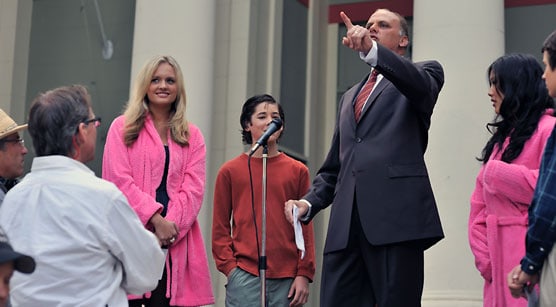
Step two is work the script.  For The Prankster, we did several different readings, at least three of them with high school students, who were our target audience.  No, they weren’t script experts, but they provided a good gauge of what would fly with teens and what wouldn’t.

Step three is acquaint yourself with fundamental storytelling principles.  You don’t have to become an ace screenwriter – that would take years, right??  But you can learn the fundamentals, like: every story must have a beginning, middle, and end.  Every story must have a protagonist who either arcs or fails to arc (tragedy).  And last, but not least, every story must be held together by a central idea or theme.  Aristotle espoused these principles over 2000 years ago, and they still pertain.

Perhaps most important, ask yourself why you want to tell a particular story.  In many cases, it’s just a case of a filmmaker casting about for material – a script is an unwelcome necessity to him or her.  If you just want to be a filmmaker because you think it’s cool, well, God Bless You, but even you would be well served to focus on figuring out what’s a good script.  Better yet, you and your audience will be served if you look within your heart and find a story (you don’t have to create it, you can find your heart in someone else’s work, preferably that of a trained screenwriter) that you believe in, that can help people.  I’m not talking about being overly serious here.  A comedy can be inspiring, a “serious” drama can and must be leavened with humor.

Find your humanity.  Realize that the purpose of storytelling is, and always has been, to put people in touch with an insight, epiphany, or idea that expands who they are.  This is sacred, and the only storytelling worth the name.

Write a comment